

Explore Delhi More!!
-
Temples
-
Mosques
-
Forts
-
Monuments
-
Tombs
-
Colonial Architecture
-
Museums
Temples
Birla Mandir
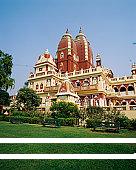
Also
Known As Birla Mandir
Strictly speaking, this structure is not part of the New Delhi Lutyens
designed. Famous Birla Mandir in Delhi is essentially a Hindu temple which came
up alongside with New Delhi and has therefore been pegged with it. Popularly
known as the Birla Mandir, it is the first of the temples built across the
country by the industrial family of Birla. Located just off Connaught Place on
Mandir Marg, it is dedicated to Vishnu, the second of the Hindu Trinity of
creator-preserver-destroyer, and his consort Lakshmi, the Goddess of wealth.
The Most
Important Temples of Hindus
Built in 1938, famous Birla Mandir in Delhi was inaugurated by Mahatma Gandhi
(Father of the Indian Nation) on the express condition that people of all
castes and especially untouchables would be allowed in. (Refer to section
People). Consequently a plaque at the gate reiterates that people of all faiths
and classes are welcome. Till date, it remains one of the most popular temples
in Delhi.
Kalkaji
Temple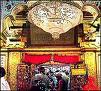
Situated beyond the commercial complex of Nehru Place lies this temple
dedicated to the goddess Kalka Devi. Its oldest section dates back to 1764 and
additions were made in the mid-19 th century.
However most of the building is modern. Thousands of pilgrims throng the
temple, especially in October during the nine days of navratrey, when a huge
fair is held here.
Kali Bari Mandir
A stone’s throw from Birla Mandir to the right is the much
smaller but quite popular temple devoted to the Goddess Kali. Especially dear
to the Bengali community of Delhi, Kali Bari Mandir in Delhi is the centre of
celebration during the festival of Durga Puja held every October. Since Kali is
believed to be the manifestation of Durga in her most terrifying, warlike
avatar, liquor is offered to the goddess in this temple.
The Kali Bari Mandir is rather small and very simple in design. From within the
temple grows a huge peepul tree that pierces through the ceiling to shade the
temple. The peepul is considered sacred by Hindus and red threads are tied
around its bark when beseeching a boon.
Lotus Temple
Lotus Temple - a modern of Delhi is one such temple that
facilitates the Bhai's Faith of Worship. The Baha’i House of Worship is
dedicated to the oneness of all religions and mankind. Subsidiary buildings
that afford relief to the suffering, sustenance to the poor, shelter to the
wayfarer, solace to the bereaved and education to the ignorant will abound
around the House of Worship.
There is no clergy in the Baha’i Faith and its service consists of prayers and
readings of selections from Baha’i scriptures, and religious texts of the other
faiths of the world.
¤ The
Bahai's Faith
The Baha’is lay great emphasis on prayer and meditation. These, they believe
are important instruments for the progress of the human soul, both in this
world and the next. The Baha’is pray to one God, the Creator of the Universe.
The act of praying is described as ‘Conversation with God’.Meditation is
perceived as the ‘Key for opening the doors of mysteries’. In that state, man
withdraws himself from all outside objects and immerses himself in the ocean of
spiritual life.
In the Baha’i Holy Writings, there are prayers for all occasions. Prayers can
be offered individually or collectively. Great importance is given to prayers
as is revealed in all the Scriptures.
However, the Baha’i Writings specify that the mere act of praying is not
sufficient. The inspiration drawn from one's prayers must be translated into
action that promotes the well being of humanity.
Delhi Mosques
Bara Gumbad Masjid
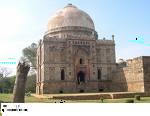 Towards
the right, set a little back from Muhammad Shah's tomb is the Bara Gumbad. This
is a square tomb with an all-encompassing massive dome, which leaves hardly any
space for a roof. It is decorated with stuccowork and painting from inside,
while the outside is a mix of grey, red and black.
Towards
the right, set a little back from Muhammad Shah's tomb is the Bara Gumbad. This
is a square tomb with an all-encompassing massive dome, which leaves hardly any
space for a roof. It is decorated with stuccowork and painting from inside,
while the outside is a mix of grey, red and black.
Jama Masjid in Delhi
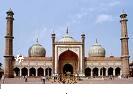 ¤
The Biggest Mosque In India
¤
The Biggest Mosque In India
Near the Red Fort about 500m away is the Jama masjid, the biggest mosque in
India. It was begun by Shah Jahan in 1650 and completed six years later and the
whole cost about a million rupees. It is hard to imagine a building more suited
to evoking the awe of the majesty of Allah in man. The mosque stands on a rocky
elevation. Its huge gateway looks down at you like fastidious connoisseur from
an immense platform which has steps that lead up to it.
Constructed in Sandstone and white marble, Jama Masjid can be entered from both
the directions - North and the South Gates. The eastern gateway is supposed to
remain open in Friday and was used by the emperor himself. Jama Masjid is
cluttered by devotees who offer namaz, especially during Muslim Festival. For
those who don't belong to non - Muslim community, a specified time is mentioned
to enter the mosque.
Begumpuri Masjid
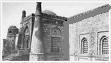
Begumpuri Masjid Jahanpanah, so lovingly planned and so carelessly given up by Muhammad-bin-Tughlaq (1325-1351), is survived by painfully little today. Remaining buildings speak of grandiose and much planning; the idea was to encompass all the Delhis before it in one all-embracing fortress. However like most ideas of Muhammad-bin-Tughlaq (see history) it defied all practical steps taken to make it a reality and Jahanpanah was left as it was when about halfway through.
Khirkee Masjid
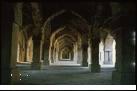
The Khirkee mosque was built by Khan-i-jahan Junan Shah the prime minister of
Feroze Shah Tughlaq in 1380. The mosque gets its name from its exquisite
windows or khirkees.
Quwwat-ul-Islam Masjid
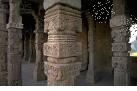 The Quwwat-ul-Islam Masjid can be a bewildering experience
for those unfamiliar with its history. On one hand there is the beautiful,
curvaceous Islamic calligraphy, the arabesque designs and then there are
pillars with clearly pre-Islamic Hindu motifs. The reason is of course quite
simple; the pillars were taken from the 27 temples of Qila Rai Pithora, the
city of the Rajput king Prithviraj Chauhan (see history). This in fact has been
recorded by Qutub-ud-din in his inscriptions, who calls it the Jami Masjid
(Friday Mosque) in his inscriptions.
The Quwwat-ul-Islam Masjid can be a bewildering experience
for those unfamiliar with its history. On one hand there is the beautiful,
curvaceous Islamic calligraphy, the arabesque designs and then there are
pillars with clearly pre-Islamic Hindu motifs. The reason is of course quite
simple; the pillars were taken from the 27 temples of Qila Rai Pithora, the
city of the Rajput king Prithviraj Chauhan (see history). This in fact has been
recorded by Qutub-ud-din in his inscriptions, who calls it the Jami Masjid
(Friday Mosque) in his inscriptions.
Delhi Forts
Delhi Red Fort
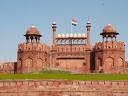
Built during the reign of Shah Jahan, the Lal Qila (or Red Fort) has been a
mute witness to innumerable conspiracies, scandals, battles..... Completed in a
span of nine years, it cost about ten million rupees , with about half the sum
going towards the building of palaces.
The fort is octagonal in shape, like most Islamic buildings in India. The north
of the fort is connected to the smaller Salimgarh fort. The Red Fort is an
intimidating structure. It measures 900m by 550m, with its rampart walls
covering a perimeter of 2.41km. It towers at a height of 33.5m. On the outside,
you can still see the moat that was originally connected with the Yamuna River.
Tughlaqabad Fort
'Ya base gujjar, ya rahe ujjar.' (May
<this city>be the abode of nomads or remain in wilderness.)
These words, with which the great Sufi saint Hazrat Nizamuddin Auliya cursed
Ghiyas-ud-din's city, seem to still echo all over the ghostly ruins of
Tughlaqabad. The citadel frowns down ominously like some Gothic palace all over
the Qutub-Badarpur road and seems to prefer its splendid isolation. Which is of
course not exactly what Ghiyas-ud-din Tughlaq had in mind when he started out
building it. It would have broken the old sultan's heart if he had seen just
how swiftly the saint's curse went into action; soon after his death in fact.
Purana Qila (Old Fort)
When the second Mughal emperor called "Humayun"
decided to make a city of his own he decided on the site of the ancient city of
Indraprastha. Humayun was quite a scholar with a fine grasp on such matters and
so it is certain that the site was chosen deliberately. When his Sher Shah Suri
overthrew him, he destroyed most of Dinpanah (refuge of the faithful) as the
city of Humayun was called to make way for his own Dilli Sher Shahi or
Shergarh. Incidentally, Humayun was probably the only emperor in history who
built a city in Delhi and did not give it his own name – this was typical of
Humayun's rather sophisticated and dreamy character. The Layout of The Massive
Colossal
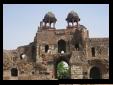
In plan the Old fort, now simply called Purana Qila by Delhites, is irregularly
orbital.
Delhi Monuments
Jantar Mantar
The Jantar Mantar was built in 1710 by Raja Jai Singh II of Jaipur (1699-1743)
in Delhi. This is an observatory consisting of mason-built astronomical
instruments to chart the course of the heavens. Jai Singh, who was a very
scholarly king with a very keen interest in astronomy and astrology, had other
observatories built too – in Ujjain, Jaipur, Mathura (which no longer survives)
and Varanasi.
The first among these was this one in Delhi. The yantras (instruments, which
has been distorted to Jantar) are built of brick rubble and plastered with
lime. The yantras have evocative names like, samrat yantra, jai prakash, ram
yantra and niyati chakra; each of which are used to for various astronomical
calculations.

Alai Minar
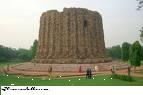
The ambitious rubble Alai Minar started by Alauddin Khalji but the sultan lived
to see it only the height of 24.5m. It was built to match the enlarged
Quwwat-ul-Islam masjid (which was also Khalji's work). Today it is used more
like an illustration, by parents, of what-happens-when-you-get-over-ambitious;
viz the plans remain unfinished. Ambition has never really been encouraged as a
virtue in India
Qutub Minar in Delhi
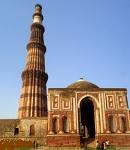 The
world famous towering Qutub Minar, started in 1192 by Qutub-ud-din Aibak
(1192-98), breathes down the neck of the Quwwat-ul-Islam mosque. There is a
slight difference of opinion as to its purpose: it probably was a tower of
victory, but then again it could have been built to be a minar (tower),
attached to the Quwwat-ul-Islam mosque, for the muezzin (priest) to climb up
top for a prayer.
The
world famous towering Qutub Minar, started in 1192 by Qutub-ud-din Aibak
(1192-98), breathes down the neck of the Quwwat-ul-Islam mosque. There is a
slight difference of opinion as to its purpose: it probably was a tower of
victory, but then again it could have been built to be a minar (tower),
attached to the Quwwat-ul-Islam mosque, for the muezzin (priest) to climb up
top for a prayer.
Delhi Tombs
Humayun's Tomb
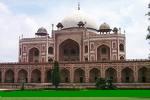
The construction of Humayun's tomb was taken up by the grief-stricken wife of
Humayun, Hamida Banu, also known as Bega Begam in 1565. Legend has it that the
design of the Taj was inspired from this tomb's. In pure architectural sense,
this building is probably superior and much more beautiful that the stunning
Taj. Sacrilege? But really, the only thing this building lacks is the showy
marble.
Sultan Ghari’s Tomb
About 8km from the Qutub Minar, on road from andheria More, is Sultan Ghari's
tomb. It was built by Altamash in 1231 for his son and heir-apparent Nasiruddin
Mahmud, who died in battle in 1229 in Lakhnauti (Lucknow). It is built in the
same style as the Quwwat-ul-Islam mosque and is assembled from assorted
destroyed Hindu temples and other buildings.
Jamali
Kamali Tomb
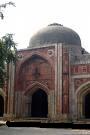
Further down is the Jamali Kamali masjid and tomb, which has recently been renovated by INTACH, an autonomous cultural organization. Jamali was the alias of the Sufi saint Shaikh Fazlullah, who was also known as Jalal Khan. The saint had a prodigious life – he lived right through Sikander Lodi's reign, the famous battle of Panipat in 1526, Babur and died during the lifetime of Humayun. Who Kamali was remains a tantalizing mystery.
The Tombs of Sheikh Alauddin and Sheikh Yusuf Qattal
On way to the masjid, a short distance away you'll probably spot the tombs of
Sheikh Alauddin (died 1541-42), descendant of the famous Sufi saint Shaikh
Faridu'd-din Shakarganj and Shiekh Yusuf Qattal (died 1527) who was a disciple
of Qazi Jalaluddin of Lahore.
The
Tomb of Altamash
In the same complex is the tomb of Shams-ud-din Altamash (1211-36), the
son-in-law and successor of Qutub-ud-din Aibak.
Altamash is widely regarded as the real founder of the Delhi sultanate and had
a very successful reign (see history).
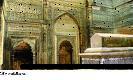 His
tomb was built in 1235 and is quite an interesting example of Islamic
architecture in India. It marks the phase when the sultans had stopped spare
parts from broken temples for their buildings. The building was made from
foundation up and not assembled.
His
tomb was built in 1235 and is quite an interesting example of Islamic
architecture in India. It marks the phase when the sultans had stopped spare
parts from broken temples for their buildings. The building was made from
foundation up and not assembled.
It seems that there had been plans to cover the tomb chamber with a dome, as is
obvious from the squinches which make their first appearance in this building.
It is said, once the dome fell but was replaced by Feroze Shah Tughlaq and then
again fell down, beating even his patience for it was not replaced.
The Tomb of Ghiyasuddin Tughlaq
South to the fortress of Tughlaqabad is the tomb of its builder, Ghiyasuddin
Tughlaq. A once fortified causeway lead to the tomb compound, which at one time
stood within a large reservoir. Ghiyas-ud-din Tughlaq was obviously a man of
set ideas – while he was about fortifying everything in sight, he fortified his
tomb as well. What against is hard to say; probably Mongols who took the term
happy hunting grounds too literally.
The reservoir is no longer stores any water and the bridge over it has been
broken off in the middle to make way for an extremely busy road. The tomb is
based roughly on a pentagon in plan and its entrance is guarded by massive
portals.
Colonial Architecture
India Gate
India
Gate is constructed as a memorial and was built in the memory of 90,00 soldiers
who laid down their lives during world war I. Located at Rajpath, India Gate is
42 m high and is popular relaxation area during the summer evenings. India Gate
also act as popular pinic spot during winter. Also known as the All India War
Memorial, India Gate was designed and constructed by Lutyens. He was the who is
considered the chief proclaimer in designing the New Delhi
plans.
Parliament House of India
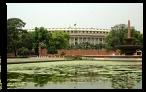
If it were not for the Montagu-Chelmsford reforms of 1919, the Parliament
House might not have been built. It’s corny how the
building most indispensable to modern Indian democracy came up as an
afterthought. Earlier called the Circular House, it was added to the layout at
a later stage following the reforms which created a large Legislative Assembly.
Rashtrapati Bhawan
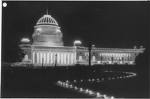 The
Viceroy Palace remains Lutyens most significant achievement. It is befittingly
the crowning glory of the British Empire and architecture in India. Today, it
is perhaps India’s best known monument after the Taj Mahal and the Qutub Minar.
Bigger than the Palace of Versailles, it cost a whopping £12,53,000 and now
houses the President of India. It is unquestionably a masterpiece of symmetry,
discipline, silhouette, colour and harmony. of course, it has come in for much
criticism too but that has mostly been limited to the imperial intent behind it
rather than its architecture.
The
Viceroy Palace remains Lutyens most significant achievement. It is befittingly
the crowning glory of the British Empire and architecture in India. Today, it
is perhaps India’s best known monument after the Taj Mahal and the Qutub Minar.
Bigger than the Palace of Versailles, it cost a whopping £12,53,000 and now
houses the President of India. It is unquestionably a masterpiece of symmetry,
discipline, silhouette, colour and harmony. of course, it has come in for much
criticism too but that has mostly been limited to the imperial intent behind it
rather than its architecture.
Delhi Museums
Dolls
Museum
Nehru
House
4, Bahadur Shah Zafar marg
New Delhi 110002.
Open 1000-1800 hours.
Crafts Museum
Bhairon Road,
New Delhi 110001.
Open 1000-1730hours; Closed: Monday
Entry free; Guided tours for groups arranged upon prior request.
Rail Museums in Delhi
Shanti Path,
Chanakyapuri.
New Delhi 1100
Open: 0930-1230, 1330-1730hours
